Shades for two-story windows, transoms and arches
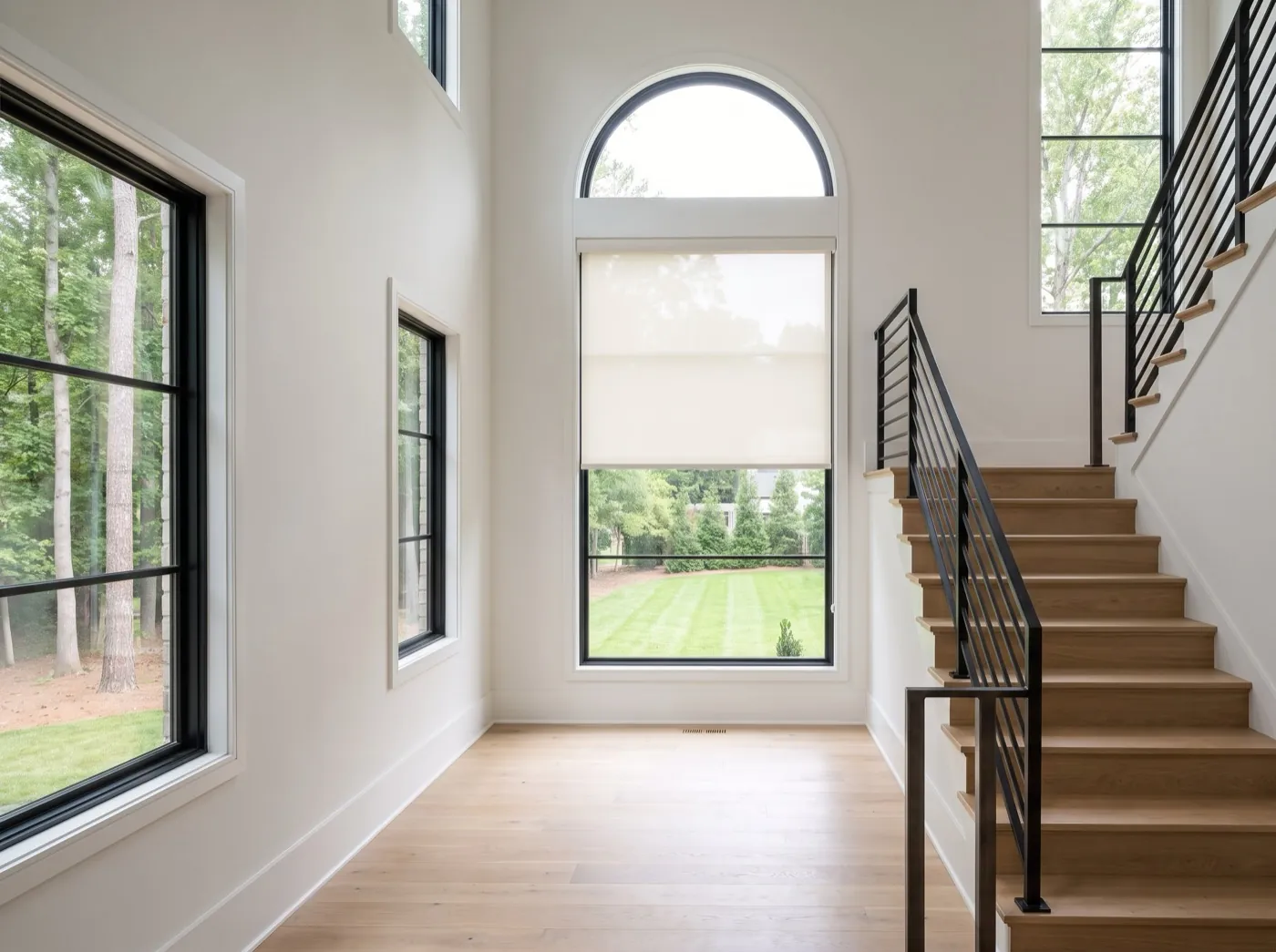
A motorized roller shade covers any rectangle, including tall ones: Lutron publishes shades up to 168 inches high. It cannot follow a curve, so on an arched window the shade covers the rectangle below and the arch stays open or gets a fixed treatment. Hardwire any shade above about 10 feet, because battery service there needs a ladder or lift.
What a roller shade can cover
A roller shade is a flat sheet of fabric wound on a straight tube. It drops straight down. That makes it good at rectangles of almost any size and unable to follow a curve or a sloped top. Makers publish these limits for a single shade.
| Maker and product | Published limit |
|---|---|
| Lutron Palladiom, wired | 144 in wide by 168 in high |
| Lutron Palladiom, wire-free | 144 in wide by 144 in high |
| Lutron Sivoia Roller 100 | 176 in wide, about 100 square feet |
| Lutron Sivoia Roller 300 | 300 square feet combined, up to 6 coupled panels on one drive |
| J Geiger Inception | 10 ft wide single, 14 ft wide coupled |
Lutron notes that its size ranges vary by fabric. In its range, the largest sizes are wired products.
Two-story great rooms and foyers
In the Atlanta suburbs, the two-story room usually has two tiers of framed windows, one above the other, with a band of wall between them. There are two ways to shade it.
- A shade for each tier. The lower shades close for privacy in the evening while the upper ones stay open for natural light, or the upper ones drop against afternoon glare while the view stays open below. This is the more useful arrangement.
- One tall shade over both tiers. It works when the total height is inside the published limit and the owner accepts fabric over the wall band. There are fewer motors, and less control.
A Sheer shade on the upper tier cuts glare and keeps the sky visible. It does not give privacy at night with the lights on.
Why to hardwire above 10 feet
A national guide states the problem in one line: "For battery-powered shades at heights over 10 feet, a ladder or lift is required for battery swaps." Published battery life runs from 6 to 12 months for rechargeable motors to 3 to 5 years for Lutron D-cell shades. Either way, someone ends up going back to the top of that window.
A hardwired shade has nothing to service at the roll. In a new build the wire costs little if it is run before drywall, as the prewire guide explains.
One South Florida dealer, Exotic Shades, says lifts for tall glass are assessed at the measure and itemized on the written quote. At Mode Shades, the upper windows of a two-story room are priced as large openings, at $1,895 to $2,995 each installed.
Transoms above windows and doors
A transom is the short fixed window above a main window or door. There are three ways to handle it.
- One shade above the transom, covering both. This is the right choice for a bedroom with a Blackout shade.
- A shade on the bar between window and transom. The transom stays open and lets light in all day. That includes early sun, so it is a poor fit for a room that needs to be dark.
- A separate small shade for the transom. It gives full control and doubles the motor count for that opening.
Options for arched and angled tops
A roller shade cannot follow an arch. Arched openings are traditional in the Mediterranean houses of Coral Gables, so the question comes up often there. The options are these.
- Shade the rectangle and leave the arch open. The shade mounts at the springline, the level where the curve begins. The arch keeps letting in light and heat. One seller's blog describes this setup and reports noticeable heat through the open arch.
- Fixed fabric in the arch, motorized shade below. A stationary sunburst panel fills the curve and does not move.
- A rectangular shade mounted above the arch. It covers the whole window when down and hides the arch. It needs clear wall above the curve.
- A specialty bottom-up shade. Krohns introduced angled and arched bottom-up roller shades in 2017. The motor sits in a tube at the bottom of the opening and cords pull the fabric upward. The trade report says Lutron and Somfy drives can be used.
Coupling and lining up hem bars
Coupling puts several fabric panels on one motor so they move as one. Lutron's Sivoia Roller 300 drives up to 6 panels. J Geiger sells a coupler bracket for building what it calls "a shade wall". The trade-off is a gap at each bracket. One seller's guide puts it at about 1 inch and advises lining the gaps up with the window mullions.
Separate motors give separate control and need electronics to stay level. Lutron publishes its alignment figure: hem bars within 1/8 inch across all shades. Its Serena FAQ says identical shades side by side move at the same speed. We found no alignment figure on the other makers' pages we read. In a room with two tiers and several windows across, uneven hem bars are the first thing the eye catches, so ask any seller for the tolerance in writing.
The windows page shows these window types with shades in place. For a price on a specific room, send photos through Get a price.
Questions owners ask
I have two or more identical shades next to each other. Will they move at the same speed?
On Lutron's Serena shades, yes: its FAQ says digital control keeps them at the same speed. Lutron publishes alignment within 1/8 inch for Palladiom. Ask other makers for their figure.
Do motors handle the weight of a 120 inch wide shade?
Yes, with the right motor and tube. Lutron publishes single shades up to 144 and 176 inches wide, and J Geiger up to 10 feet single and 14 feet coupled.
How do you motorize an arched window?
Usually you do not motorize the arch. The shade covers the rectangle below and the arch stays open or gets fixed fabric. Bottom-up specialty shades exist for arched and angled openings.
Do I need hard-wiring for motors?
Not everywhere. For windows above about 10 feet, hardwiring is strongly advised, because battery service needs a ladder or lift.