Shades for sliding and French doors
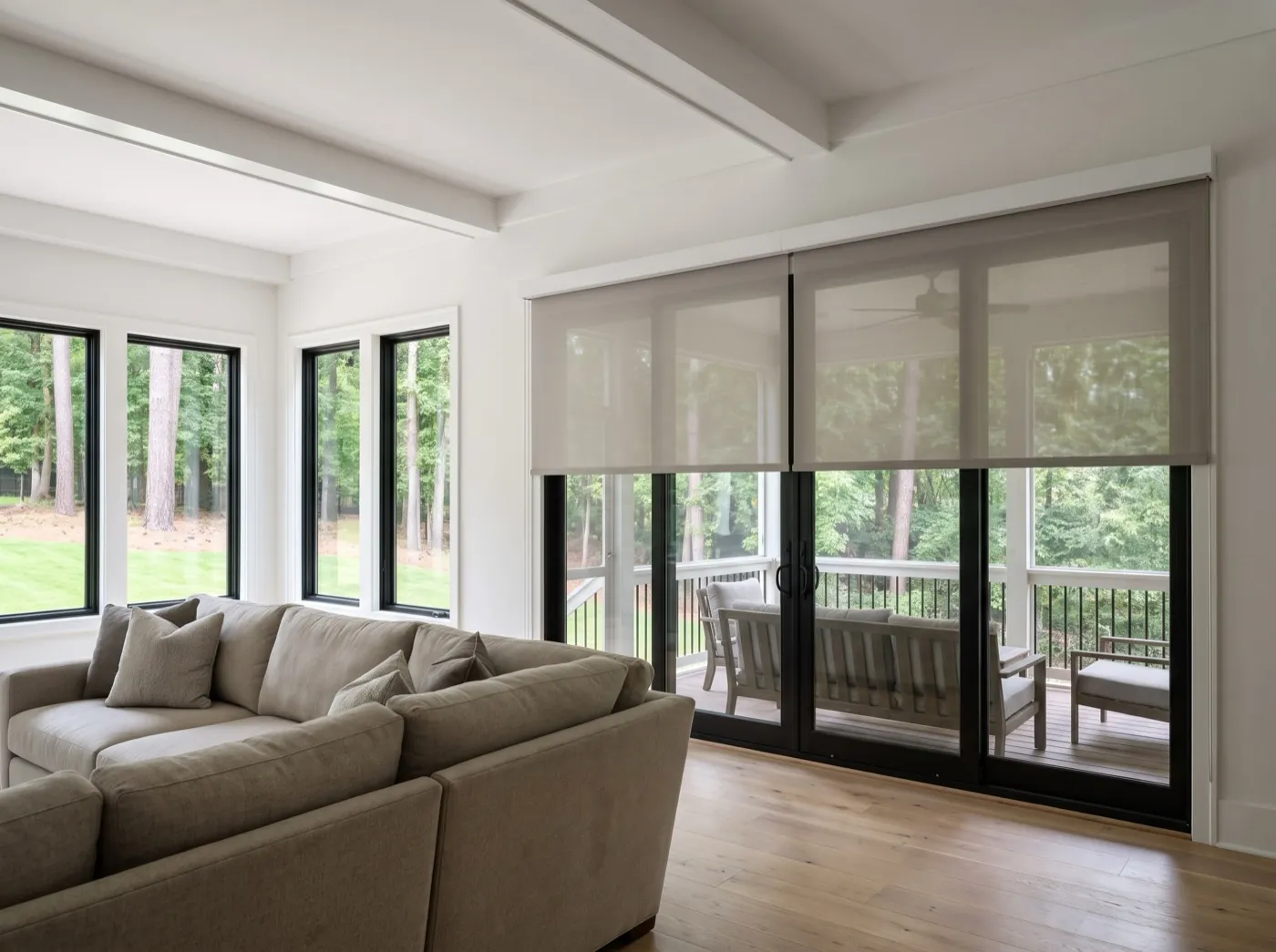
A sliding door takes one wide shade or one shade per panel, mounted above the frame so the door still moves. Makers publish single-shade widths of 144 to 176 inches, so most doors up to 12 feet can use either. French doors usually take one shade on each leaf with hold-downs, or one shade above the frame.
Sliding doors: one shade or several
Sliding doors now account for about 60% of patio doors in new single-family homes, and multi-panel moving glass walls are in about 8% of them, mostly in the South and West. Andersen lists two-panel gliding doors from 4 feet to 6 feet 4 inches wide and three-panel doors at 8 and 9 feet, in heights from 6 feet 8 inches up to 10 feet on some lines.
A shade on a slider mounts above the door, on the wall, under a fascia or in a ceiling pocket. The choice is between one wide shade and a shade for each panel.
| One wide shade | One shade per panel | |
|---|---|---|
| Look when down | One sheet of fabric, no gaps | A gap at each bracket, about 1 inch by one seller's guide, lined up with the door stiles |
| Using the door | The whole opening uncovers together | Raise only the shade over the panel that opens; the rest stay down |
| Width | Limited by the maker: 144 to 176 inches published | No practical limit |
| Suits | Doors up to about 12 feet where the view matters most | Multi-panel doors and doors used all day |
Speed is part of the decision. At Lutron's published bottom bar speed of 3.6 inches per second, a shade takes about 27 seconds to clear an 8-foot door. With split shades, only the one over the active panel has to move. There is a middle route as well: a franchise guide describes splitting a very wide run into "two coupled shades that move together on a single command."
Width limits published by shade makers
| Maker and product | Widest single shade |
|---|---|
| J Geiger Inception | 10 ft single, 14 ft coupled |
| Graber roller and solar shades | 144 in |
| Lutron Palladiom | 144 in |
| Lutron Sivoia Roller 64 | 144 in, about 64 square feet |
| The Shade Store motorized roller | 156 in |
| Lutron Sivoia Roller 100 | 176 in, about 100 square feet |
Width is not the only limit. Lutron also caps the area of each shade. A door 12 feet wide and 8 feet tall is 96 square feet, which is past the Roller 64 and inside the Roller 100. The Shade Store notes that shades over 90 inches wide may need larger brackets or valances.
French doors: on the door or above
On the door. One shade goes on each leaf, fixed to the door over the glass. Lutron's Serena FAQ confirms the principle: "Serena roller shades can be securely mounted on doors." The shade travels with the door, so the door works whether the shade is up or down. A shade hanging from a swinging door will sway and tap the glass, so door-mounted shades are fitted with hold-down brackets that keep the hem bar against the door. That detail is common trade practice; it is not spelled out on the Lutron page. Door-mounted shades are normally wire-free, because a fixed wire cannot easily cross a hinge.
Above the frame. One shade, or one per leaf, mounts on the wall or in a pocket above the doors. Nothing is attached to the doors, and the shade can be hardwired and hidden like any window shade. The cost is convenience: with the shade down, an in-swing door cannot open until the shade is raised.
The systems page shows pocket, fascia and open roll.
Clearance for handles and door travel
One franchise measuring list names it directly: "Clearance for door handles and the path of the sliding panels."
- Sliding doors. The fabric has to hang in front of the handle without rubbing, so the roll sits far enough off the glass to clear it.
- French doors. A lever handle sits beside the glass. The shade is either narrow enough to pass inside the handle or spaced off the door to pass in front of it.
- Head height. A surface headrail takes some of the opening. Lutron's Serena FAQ gives 4.5 inches of fascia or headrail over the glass with the shade fully up. A pocket above the door avoids that.
Blackout on a bedroom door
Blackout fabric stops light through the fabric. The edges are the weak point. Lutron's Serena FAQ says blackout fabrics "prevent light from passing through the shade material" but gaps "may allow some light in around the edges of the window."
On a door, three things help. Mount the shade above the frame and make it wider than the glass; The Shade Store advises adding 1-1/2 to 2 inches on each side of an outside mount to cut light leakage. Use one wide shade where the width allows, because every split adds a gap. Where side channels fit, they close the edges further; Screen Innovations publishes light gaps as small as 3/4 inch for one of its lines. A Blackout shade on a door will be dark, not sealed.
What door shades cost installed
Mode Shades prices doors as large openings: $1,895 to $2,995 each, installed. The cost guide shows how doors fit into a whole-house total, and Get a price takes phone photos of the doors.
Questions owners ask
Can roller shades work on sliding glass doors?
Yes. The shade mounts above the door and drops in front of it. Published single-shade widths reach 144 to 176 inches, and wider doors are split into two or more shades.
Can I install motorized shades on a door?
Yes. Lutron's Serena FAQ says its roller shades can be securely mounted on doors. Each leaf gets its own shade, and hold-downs keep the hem bar from swinging.
How do you cover large patio doors with motorized roller shades?
With one wide shade when the door is inside the maker's width and area limits, or with split or coupled shades when it is not. Check handle clearance and the path of the sliding panels at the measure.
Do these shades completely block sunlight from entering a room?
No. Blackout fabric blocks light through the material, but some light comes in around the edges. An outside mount that overlaps the opening reduces it.