Sheer, privacy or blackout shades?
A sheer (solar screen) shade cuts glare and keeps the view, but it does not give privacy at night with the lights on, at any openness from 1% to 10%. A privacy fabric blocks the view both ways and still lets light in. Blackout fabric stops light through the cloth, though the side gaps still leak. A dual shade puts a sheer and a blackout on one window.
What sheer, privacy and blackout fabrics do
A roller shade is one sheet of fabric, so the fabric decides the view, the glare, who can see in, and how dark the room gets. There are three families.
- Sheer. A solar screen fabric with an open weave. It cuts glare, keeps the view, and gives privacy by day only. See solar shades.
- Privacy. A closed weave, also called translucent. Daylight comes through as a glow, with no view either way. See light filtering shades.
- Blackout. An opaque fabric. Light does not pass through the cloth, but it can pass around it. See blackout shades.
| Fabric | View out by day | Privacy by day | Privacy at night, lights on | Darkness | Installed, per standard window |
|---|---|---|---|---|---|
| Sheer | Yes | Yes | No | No | $895 to $1,295 |
| Privacy | No | Yes | Yes | No | $895 to $1,295 |
| Blackout | No | Yes | Yes | Yes, except at the edges | $1,095 to $1,495 |
| Dual (sheer plus blackout) | Yes, on the sheer | Yes | Yes, on the blackout | Yes, except at the edges | $1,795 to $2,495 |
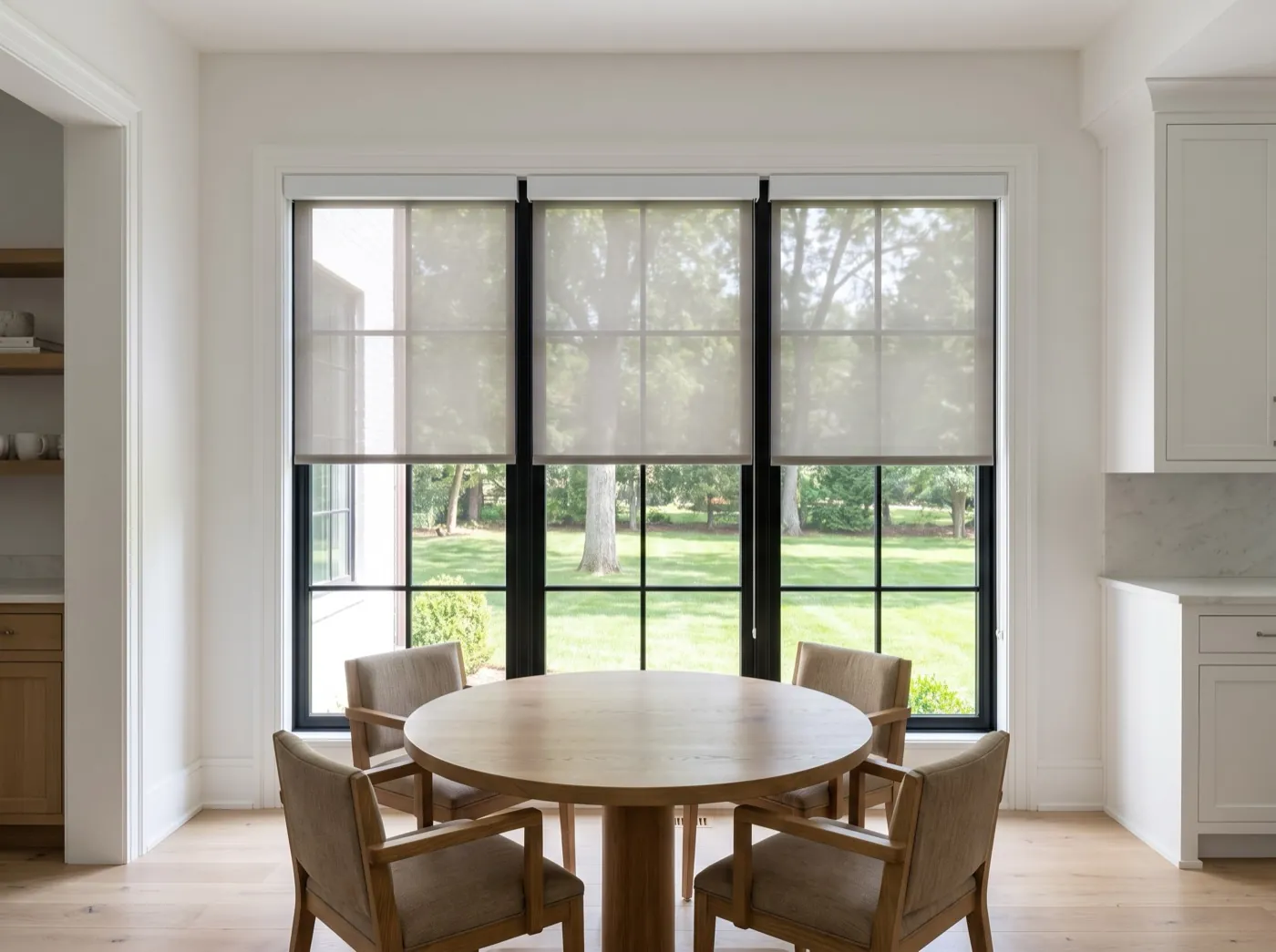
What 1%, 3%, 5% and 10% openness mean
Openness is the share of a sheer fabric that is open weave. The Shade Store lists 1%, 3%, 5% and 10% as the common levels, and the fabric maker Mermet weaves its E Screen from 0.5% to 10%. A lower number is a tighter weave that screens more. A higher number keeps more of the view.
| Openness | UV blocked | What you see by day | What the neighbors see by day | What the neighbors see at night, lights on |
|---|---|---|---|---|
| 1% | 99% | A faint view | Almost nothing | Still see-through |
| 3% | 97% | Little of the view | Very little | Still see-through |
| 5% | 95% | Soft light, more of the view | Little | Still see-through |
| 10% | 90% | The most light, the best view | The most of the four | A full view of the room |
The UV figures come from one seller, Affordable Blinds. Mermet publishes 90% to 99% for its E Screen range. Color also changes the result: The Shade Store says lighter colors generally give more privacy than darker ones. A dark sheer gives the clearest view out and the least privacy.
Why sheer shades fail at night
A sheer shade works by day because the outside is brighter than the room. At night with the lights on, that reverses, and people outside can see in. The Shade Store states that solar shades should not be relied on for full nighttime privacy. Blinds To Go says that at 7% to 10% openness, onlookers get a full view of the inside of the house.
Some sellers suggest 1% to 3% for night privacy. A tighter weave shows less, but it is still see-through, so do not count on it in a bedroom, a bath or a street-facing room. A privacy fabric is safer there. Ask to see the sample lit from behind, because a thin fabric can show the shadow of a person standing close to it.
When dual shades solve the problem
A dual shade puts two rolls at one window: a sheer for the day and a blackout for the night. It gives a daytime view and real night privacy at the same window.
Two rolls need more room at the head of the window. Lutron lists single recessed pockets from 3.5 inches and dual pockets at 5.5 by 7.5 inches and 7 by 11 inches. If the shades will sit in a ceiling pocket, decide on dual before the ceiling is closed. The mounting guide covers what a finished house can still do.
Dual costs about twice a single shade: $1,795 to $2,495 against $895 to $1,295 per standard window, installed. Use it where it earns its place: the primary bedroom, a street-facing living room, a bath with a view.
Light gaps and side channels for blackout
Blackout fabric stops light through the cloth. Lutron's Serena FAQ adds the honest part: gaps may still let light in around the edges. The fabric of a roller shade is narrower than its brackets. The Shade Store's measuring guide puts the fabric of a motorized roller 1-3/8 to 1-5/8 inches narrower than the bracket-to-bracket width. Screen Innovations publishes light gaps as small as 3/4 inch on one line.
- Outside mount with overlap. The same guide suggests adding 1-1/2 to 2 inches on each side so the fabric covers the gap.
- Side channels. Slim tracks that the fabric edges run in. Lutron lists them as an option on its Sivoia line. They suit a media room or a light-sensitive sleeper.
- Accept the gap. Without channels, a blackout shade makes a bedroom dark, not black. Decide whether dark is enough.
Which fabric goes in which room
- Living room, kitchen, office: sheer. One seller suggests 5% or higher for these rooms. Go lower where glare is the main problem.
- Bedrooms: blackout, or dual to keep the daytime view.
- Baths and closets: privacy.
- Street-facing rooms used at night: dual, or privacy if the view does not matter.
- Media room: blackout with side channels.
Mode Shades sets the fabric room by room in a priced design made from your plans or phone photos. Get a price for your house.
Questions owners ask
Do solar shades provide privacy?
By day, yes. A solar (sheer) fabric hides the room while the outside is brighter than the inside. At night with the lights on, it does not.
What does the openness percentage mean for solar shades?
It is the share of the weave that is open. 1% is the tightest common weave and 10% the most open.
Can people see in through solar shades at night?
Yes, when the lights are on, at every openness. The fix is a second blackout or privacy layer, which is what a dual shade is.
Do blackout shades completely block sunlight from entering a room?
The fabric does. The edges do not. Expect a strip of light on each side unless you add side channels or an outside mount with overlap.
Are blackout motorized shades more expensive than regular motorized shades?
Yes. Our installed range is $1,095 to $1,495 for blackout against $895 to $1,295 for sheer or privacy, per standard window.