Inside mount, outside mount, fascia or pocket?
By The Shade Store's published measuring guide, an inside mount needs 3/4 inch of frame depth to hold a motorized roller shade and 2-1/4 to 3-3/4 inches for the shade to sit fully inside the frame. An outside mount needs no depth. A finished house can take fascia or open roll shades with no ceiling work. A pocket means opening the ceiling.
Inside mount and outside mount compared
An inside mount puts the shade within the window frame. It looks built in and leaves the trim showing. An outside mount puts the shade on the wall, the trim or the ceiling above the window. It covers more and needs no frame depth.
The Shade Store publishes the depths its roller hardware needs. Other makers' hardware differs, so treat this as a guide to what your frames allow.
| Mount | Depth or space needed |
|---|---|
| Inside mount, held securely (the roll may stand proud of the frame) | 3/4 inch |
| Inside mount, flush, brackets fixed to the top of the frame | 2-1/4 inches |
| Inside mount, flush, brackets fixed to the sides, battery motor | 3 inches |
| Inside mount, flush, brackets fixed to the sides, plug-in or hardwired motor | 3 to 3-3/4 inches |
| Inside mount, flush, with a metal valance | 3-5/8 to 4-3/8 inches |
| Double roller with a metal valance, flush | 2-5/8 to 3-7/8 inches |
| Outside mount | No minimum depth; 1 to 2-1/4 inches of flat surface for the bracket |
| Outside mount, overlap past the opening | 1-1/2 to 2 inches on each side |
The same guide notes that shades over 90 inches wide or 100 inches long may need larger brackets.
Pocket, fascia and open roll explained
The mount says where the shade sits. The system says what you see at the top. There are three systems.
- Pocket. The roll is recessed in the ceiling. With the shade up, only a slot shows. Lutron lists single pockets at 3.5, 4, 5 and 7 inches and dual pockets at 5.5 by 7.5 inches and 7 by 11 inches. Dual pockets hold two rolls, such as a sheer and a blackout.
- Fascia. A slim metal cover in front of the roll. Lutron lists fascia at 2.75, 3.5 and 4 inches. Crestron lists 3 inches, and 4-3/4 inches for larger shades.
- Open roll. The roll is exposed on a machined bracket and is meant to be seen. J Geiger's jamb bracket is under 2.5 inches in diameter and suits a 3 inch jamb. Screen Innovations' open roll is 2.5 inches tall. Lutron's Palladiom takes no more than 3.25 inches of height.
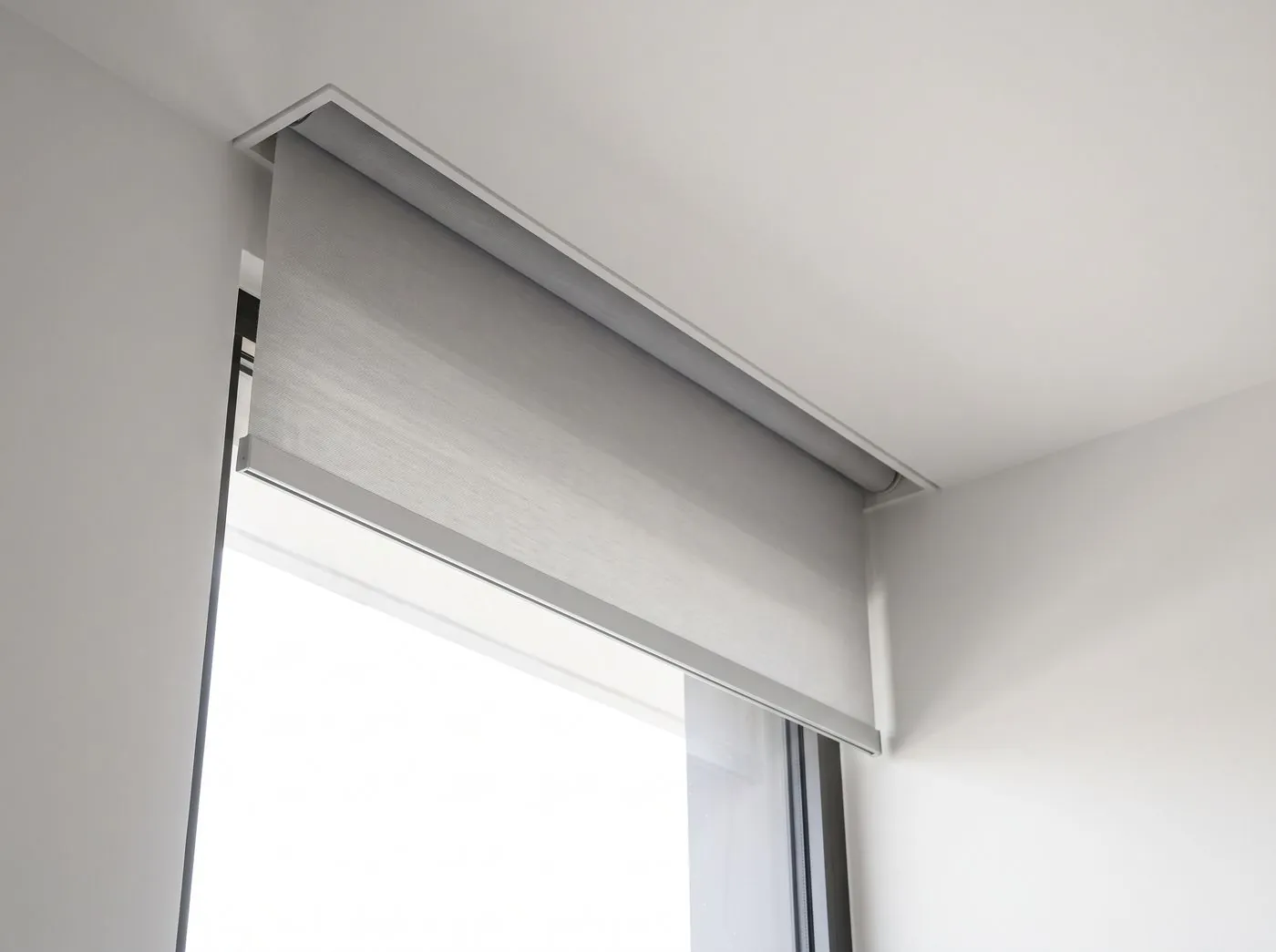
| System | What shows when the shade is up | Published sizes | Possible in a finished house |
|---|---|---|---|
| A slot in the ceiling | 3.5 to 7 inches single; up to 7 by 11 inches dual | Only by opening the ceiling | |
| Fascia | A metal cover | 2.75 to 4-3/4 inches | Yes |
| Open roll | The fabric roll and its brackets | 2.5 to 3.25 inches | Yes |
On an inside mount the hardware covers the top of the glass. Lutron says 4.5 inches of fascia and headrail cover the window when its Serena roller shade is open. A pocket, or an outside mount above the frame, gives that glass back.
Where the light gaps come from
The fabric of a roller shade is narrower than its brackets. The Shade Store puts the fabric of a motorized roller 1-3/8 to 1-5/8 inches narrower than the bracket-to-bracket width. Screen Innovations publishes light gaps as small as 3/4 inch on one line. On an inside mount, that gap is a strip of light down each side.
For a sheer shade the gap hardly matters. For blackout it does. The fixes are an outside mount with 1-1/2 to 2 inches of overlap per side, or side channels. The fabric guide covers both.
What a finished house can still do
- Inside mount where the frame is deep enough. Measure it. 3/4 inch holds a shade, and 2-1/4 inches or more hides it in the frame. Deep masonry reveals, common in older Mediterranean houses in South Florida, make this easy.
- Fascia or open roll above the window. Mounted on the wall, the trim or the ceiling, with no depth needed and no ceiling work.
- Wire-free power. Lutron describes its battery lines as made for retrofits. Hardwired power means a wire to every window, which is simple in a new build and can mean opening walls in a finished one.
- Pocket, during a remodel. If the ceiling is coming down anyway, a pocket is possible. In a new build it is planned at framing. See the pre-wire guide.
A roller shade cannot follow an arched top, so the shade covers the rectangle below. The windows page shows each case.
How to check your own windows
- Measure the frame depth at the top of the window, from the glass side to the room side.
- Note anything that sticks out: cranks, handles, locks.
- Check the flat space above the frame and at the ceiling.
- Take a straight-on phone photo of each window type in the house.
Mode Shades works from plans or phone photos to a priced design. A site measure follows before anything is made. Get a price for your house.
Questions owners ask
How deep does my window need to be to fully recess a roller shade?
By The Shade Store's guide, 2-1/4 inches with brackets fixed to the top of the frame and 3 to 3-3/4 inches with brackets fixed to the sides.
How much of the window will be blocked when the shade is open?
On an inside mount, the height of the hardware. Lutron gives 4.5 inches for its Serena roller shade. A pocket or an outside mount above the frame blocks none of the glass.
Can you add motorized shades to a house that's already built?
Yes. Fascia and open roll systems mount without ceiling work, and wire-free motors need no new wiring. Only the pocket needs the ceiling opened.
Do motorized window shades require professional installation?
Not always. Lutron describes its Serena line as DIY or pro-installed. Whole-house systems with hardwired power and keypads are installed by a crew.
How long does it take to install motorized window treatments?
One Florida dealer publishes its timeline: fabrication about three to four weeks, then a day of installation, two at most for a whole home, at roughly thirty minutes per window.